
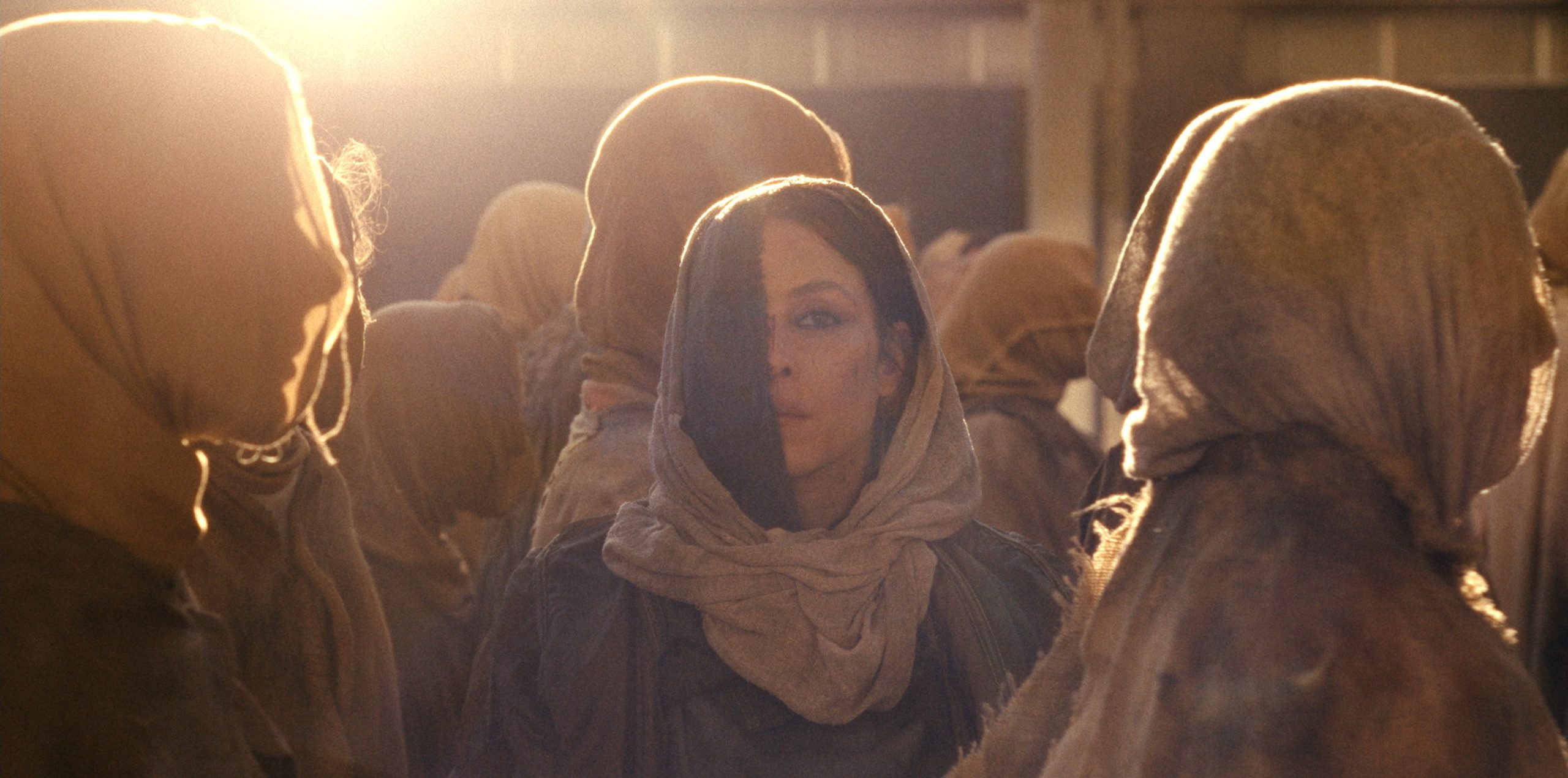
In an era where science fiction cinema increasingly plays it safe with familiar franchises and predictable narratives, director Agnieszka Smoczynska has delivered something genuinely audacious with her new film ‘Hot Spot.’ The Polish filmmaker, known for her boundary-pushing work including the genre-defying mermaid horror musical ‘The Lure,’ has crafted a dystopian thriller that defies easy categorization. Starring Swedish actress Noomi Rapace, the film plunges viewers into a world populated by cyber witches, parasitic blood-transfusion worms, and an all-powerful artificial intelligence known simply as ‘The Head’ that has rendered humanity utterly dependent on technology for survival. It’s a fever dream of retrofuturist aesthetics and philosophical provocation that critics are already comparing to Frank Herbert’s ‘Dune’ — if Dune had been conceived during a particularly intense hallucination.
The visual landscape of ‘Hot Spot’ is nothing short of extraordinary. Smoczynska has created a world where dried-up, post-apocalyptic terrain sits alongside crumbling ancient Greek ruins, all filtered through an unmistakable 1980s noir sensibility. The costume design evokes the shoulder-padded excess of that decade while incorporating biomechanical elements that feel both alien and disturbingly organic. This collision of past, present, and imagined future creates a disorienting temporal experience that keeps audiences perpetually off-balance. The director has cited influences ranging from Ridley Scott’s original ‘Blade Runner’ to the body horror of David Cronenberg, and these touchstones are evident in every meticulously crafted frame.
Noomi Rapace Returns to Science Fiction Territory
At the center of this hallucinatory narrative is Noomi Rapace as Rana, a rebel leader who has made the radical choice to remain disconnected from the technological system that controls virtually all human life. Rapace, who first captured international attention as Lisbeth Salander in the original Swedish ‘Girl with the Dragon Tattoo’ trilogy, has become something of a science fiction icon in recent years. Her roles in Ridley Scott’s ‘Prometheus’ and the Apple TV+ series ‘Constellation’ have established her as an actress drawn to complex, physically demanding characters navigating hostile environments. Yet Smoczynska insists that ‘Hot Spot’ represents something different from her previous genre work. This isn’t simply another iteration of the tough sci-fi heroine archetype; Rana exists in morally ambiguous territory, her motivations never fully transparent to the audience.
The film’s central mystery unfolds as a detective story, though Smoczynska deliberately eschews conventional narrative structure. Rather than guiding viewers methodically from plot point to plot point, she embraces ambiguity and sensory experience over logical progression. This approach has divided early critics, with some praising the film’s commitment to atmospheric immersion while others have found the opacity frustrating. Smoczynska herself has been remarkably candid about her intentions, openly stating that she isn’t particularly concerned with whether audiences can follow every thread of the narrative. Her philosophy seems to align with filmmakers like David Lynch, who famously resists explaining his work, preferring that viewers engage emotionally and intuitively rather than intellectually.
The Emergence of Visionary European Science Fiction
‘Hot Spot’ arrives at an intriguing moment for European science fiction cinema. While Hollywood continues to dominate the genre with massive franchise productions, filmmakers from Poland, France, Denmark, and other European nations have been quietly developing more experimental approaches to speculative storytelling. Smoczynska’s background in Polish cinema, with its tradition of political allegory and artistic risk-taking, informs every aspect of the production. The concept of ‘The Head’ — an AI that has made itself indispensable to human survival — resonates with contemporary anxieties about artificial intelligence, algorithmic control, and technological dependency. Yet the film refuses to deliver simple warnings or moralistic conclusions, instead immersing viewers in the experiential reality of such a world.
The production design incorporates practical effects alongside digital enhancement, creating a tactile quality often missing from CGI-heavy science fiction. The blood-transfusion worms, for instance, were created using a combination of animatronics and subtle computer augmentation, lending them an unsettling physicality that purely digital creatures rarely achieve. This commitment to practical craftsmanship extends to the film’s environments, many of which were built as physical sets rather than generated in post-production. The result is a world that feels lived-in and genuinely dangerous, a place where the violence and grotesquerie have weight and consequence. For audiences seeking science fiction that challenges rather than comforts, ‘Hot Spot’ represents exactly the kind of ambitious, uncompromising vision the genre needs.
Expert Opinion: ‘Hot Spot’ signals a potentially significant shift in science fiction filmmaking, where European directors are reclaiming the genre’s experimental roots from Hollywood’s franchise-dominated landscape. Smoczynska’s willingness to prioritize atmosphere and thematic complexity over narrative clarity may alienate mainstream audiences, but it positions her as a vital voice in contemporary cinema. Expect this film to develop a devoted cult following and influence a new wave of filmmakers seeking alternatives to conventional genre storytelling.